A selection of Sh3d’s work across embedded devices, remote communications, power management and automation.
This is the multi-page printable view of this section. Click here to print.
Projects
Examples of systems, devices and integrations Sh3d has built.
- 1: Waves In Ice
- 2: Gateways
- 3: Battery Management
- 4: MPPT
- 5: LoRa
- 6: LPWAN
- 7: Satellite
- 8: Satellite Trackers
- 9: Computer Vision
1 - Waves In Ice
Custom wave buoys deployed in Arctic and Antarctic sea ice — published in Nature.
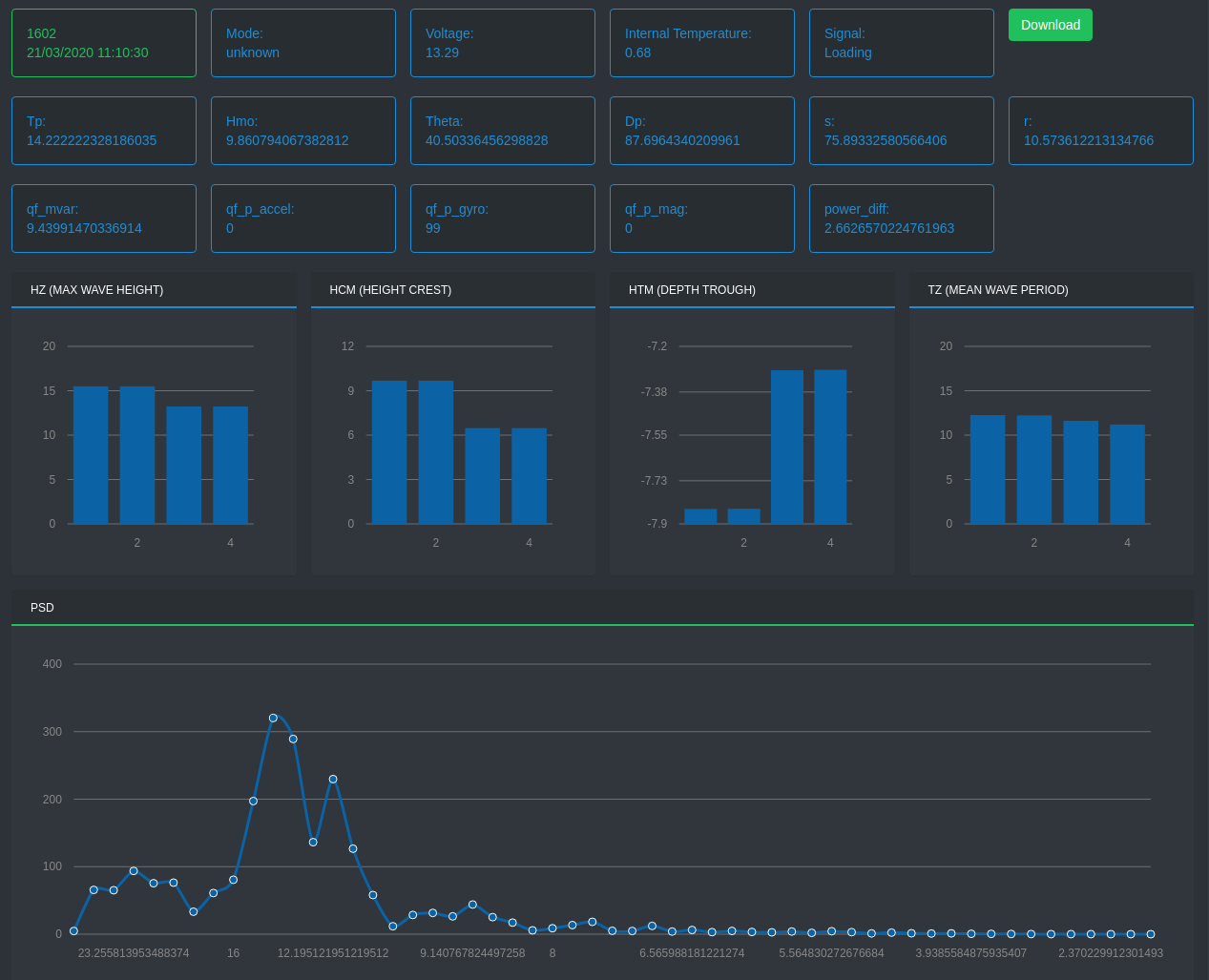
Waves-In-Ice (WII) are custom wave buoys deployed in the Arctic and Antarctic on sea-ice floes. Results from their long-running deployments have been published in Nature.
The latest generation is released as open source — hardware, firmware, and the wave-statistics maths — at wii5.sh3d.com.au.
Dashboard — positions

Dashboard — single capture
2 - Gateways
Custom gateways bridging device protocols to cloud services — with a full local copy of all data.
Sh3d builds custom gateways that bridge any device protocol — Bluetooth, LoRa, satellite, proprietary radio — to cloud services, while keeping a full local copy of all data.
| Aspect | Detail |
|---|---|
| Hardware | Low-power, low-cost |
| Device software | Custom, purpose-built |
| Protocols | Any: Bluetooth, LoRa, LPWAN, Iridium |
| Local management | Full local copy of all data |
3 - Battery Management
Two decades of battery system design — from lead-acid solar to tiny devices running for years on a single AA.
Sh3d has built and managed battery systems for two decades — from lead-acid solar installations down to tiny embedded systems running on a single AA cell for years.
The WII wave buoys sleep for years and run in full-capture mode for months, automatically switching between capture, low-power and sleep modes to maximise longevity, reliability and recoverability.
Battery management is done at a low level: higher-level CPU loads and power drains are progressively shut down so GPS and communications can continue running, allowing a device to be located even when its main systems have failed.
See also MPPT.
4 - MPPT
Tiny MPPT charger for Li-ion battery packs on solar-powered wave buoys in extreme cold.
In 2010 Sh3d designed a tiny MPPT to charge lithium-ion batteries from solar panels mounted on wave buoys deployed in very cold conditions. Battery management included temperature control and MPPT across multiple panels facing different directions (due to the physical design of the buoy).
Lithium batteries don’t handle low temperatures well — non-rechargeable alkaline cells are the best choice for extreme cold. Combining MPPT, careful battery and temperature monitoring, and fall-back alkaline cells, the buoys ran for many months even with rechargeable Li-ion packs.
5 - LoRa
Custom LoRa and LoRaWAN devices with integration into local and any gateway.
Long-range radios
Sh3d has been using long-range radios for many years across farm, environmental and industrial sensing projects — both plain LoRa and LoRaWAN, as well as MeshCore.
| Aspect | Detail |
|---|---|
| Hardware | Low-power, low-cost |
| Device software | Custom LoRa and LoRaWAN devices |
| Edge software | Integration with local and any gateway |
To debug and tune these networks at the radio layer we built LoRaScope — a single-radio LoRa / MeshCore / LoRaWAN spectrum & traffic analyser.
6 - LPWAN
Low-power wide-area networking for IoT — Cat-M1, LTE-M and NB-IoT.
Technologies
- Cat-M1
- LTE-M
- NB-IoT
Access to IoT device protocols from Telstra and networks globally.
7 - Satellite
Low-cost satellite data for remote sensing where no other network will do.
Satellite Communications
Useful for small amounts of data from places nothing else can reach.
Examples
Wave buoys
Antarctic and Arctic wave-buoy telemetry via Iridium — see Waves In Ice.
Farm sensors
Water tanks, weather stations and other remote rural monitoring.
See also Gateways.
8 - Satellite Trackers
Standalone Iridium trackers used as an independent backup for critical equipment.
Many tracking systems have been built over the years, including those built into farm equipment and wave buoys. Sh3d also built standalone custom Iridium satellite trackers, used to keep track of multicopters in the harsh conditions of Antarctica.
By being stand-alone and independent from the main systems, these trackers acted as a reliable backup in case of device loss.
9 - Computer Vision
Using cameras and trained models to monitor real-world systems non-invasively.
Computer vision is a very useful field. Instead of building a specialised sensor to monitor a single object — e.g. the position of a gate — the same job can be done with a camera. Automatic identification of trained objects (signs, gates, vehicle types) is possible.
Devices that can’t normally be monitored (e.g. an older device with only LEDs for output, which can’t be opened or modified) can still be brought into a real-time data system. Imagine adding oil-level monitoring to an old water pump without any modification to the pump itself.
More advanced applications include monitoring the depth of a water tank or dam.